Donnerstag, 19. April 2012

My Audiobook Collection

With the exception of books on software development, I don't really read a lot of printed books any more, as I prefer to listen to audiobooks (and podcasts). They are just such a time saver. This is my audiobook collection so far:

  • 1776 (Unabridged), Part 1
  • 1776 (Unabridged), Part 2
  • 50 Philosophy Ideas You Really Need To Know (Unabridged)
  • A Short History of Nearly Everything (Unabridged), Part 1
  • A Short History of Nearly Everything (Unabridged), Part 2
  • A Short History of Nearly Everything (Unabridged), Part 3
  • Abraham Lincoln: A Life 1809-1837: Lincoln's Frontier Background Shapes the Future President (Unabridged)
  • Abraham Lincoln: A Life 1843-1849: A Win in Congress and a Battle Against Slavery (Unabridged)
  • Abraham Lincoln: A Life 1849-1855: A Mid-Life Crisis and a Re-Entry to Politics (Unabridged)
  • Abraham Lincoln: A Life 1855-1858 (Unabridged) Part 1
  • Abraham Lincoln: A Life 1855-1858 (Unabridged) Part 2
  • Abraham Lincoln: A Life 1859-1860 (Unabridged)
  • Alexander the Great (Unabridged), Part 1
  • Alexander the Great (Unabridged), Part 2
  • American Lion: A Biography of President Andrew Jackson Part 1
  • American Lion: A Biography of President Andrew Jackson Part 2
  • Ancient Philosophy (Unabridged)
  • Außer Dienst
  • Biography: Attila The Hun
  • Business Startup: Launch Your Dream (Unabridged)
  • China. Das alte und das neue Reich der Mitte
  • Churchill
  • Das Buch vom geglückten Leben
  • Das Mittelalter - Teil 1 und 2 (P.M. History)
  • Das Philosophen Portal. Ein Schlüssel zu klassischen Werken
  • Das Reich der Pharaonen (P.M. History)
  • David Hume (Unabridged)
  • Delivering Happiness: A Path to Profits, Passion, and Purpose (Unabridged)
  • Der 30jährige Krieg
  • Der Mensch. Vom Ursprung der Kultur
  • Die Kraft des Lebens. Schopenhauers Welt als Wille und Vorstellung
  • Die Völkerwanderung
  • Elizabeth and Mary: Cousins, Rivals, Queens
  • Fire in the East - Warrior of Rome (Unabridged) Part 1
  • Fire in the East - Warrior of Rome (Unabridged) Part 2
  • From Start-Up to Success in Internet Years
  • Geheimnis Sterben (Shortbooks)
  • Genghis Khan and the Making of the Modern World (Unabridged) Part 1
  • Genghis Khan and the Making of the Modern World (Unabridged) Part 2
  • Hannibal: One Man Against Rome (Unabridged), Part 1
  • Hannibal: One Man Against Rome (Unabridged), Part 2
  • Heroes of History (Unabridged), Part 1
  • Heroes of History (Unabridged), Part 2
  • Immanuel Kant (Unabridged)
  • Inside Larry's and Sergey's Brain (Unabridged)
  • John Adams
  • Kleine Geschichte der Philosophie 1
  • Kleine Geschichte der Philosophie 2
  • Lion in the White House (Unabridged)
  • Nietzsche für Eilige
  • Personal Memoirs of Ulysses S. Grant (Unabridged) Part 1
  • Personal Memoirs of Ulysses S. Grant (Unabridged) Part 2
  • Personal Memoirs of Ulysses S. Grant (Unabridged) Part 3
  • Personal Memoirs of Ulysses S. Grant (Unabridged) Part 4
  • Philosophie der Stoa
  • Philosophische Vitamine. Die Kunst des guten Lebens
  • Resolute Determination (Unabridged)
  • Schnellkurs Altes Ägypten
  • Schnellkurs Deutsche Geschichte
  • Schnellkurs Griechische Antike
  • Schuld und Sühne (Teil 1 und 2)
  • Schuld und Sühne (Teil 3 und 4)
  • Schuld und Sühne (Teil 5 und 6)
  • The 7 Habits of Highly Effective People: Powerful Lessons in Personal Change (Unabridged), Part 1
  • The 7 Habits of Highly Effective People: Powerful Lessons in Personal Change (Unabridged), Part 2
  • The Book of Leadership Wisdom
  • The Death of Ivan Ilych (Unabridged)
  • The First Americans: Prehistory - 1600 (Unabridged)
  • The God Delusion (Unabridged) Part 1
  • The God Delusion (Unabridged) Part 2
  • The Hundred Years War, Volume 1 (Unabridged), Part 1
  • The Hundred Years War, Volume 1 (Unabridged), Part 2
  • The Killer Angels (Unabridged), Part 1
  • The Killer Angels (Unabridged), Part 2
  • The Late Roman Empire (Unabridged)
  • The March of the Ten Thousand (Unabridged)
  • The Modern Scholar: Alexander of Macedonia
  • The Modern Scholar: Antiquity to Renaissance
  • The Modern Scholar: Discovering the Philosopher in You: The Big Questons in Philosophy
  • The Modern Scholar: Epochs of European Civilization: Reformation to the 21st Century
  • The Modern Scholar: Ethics: A History of Moral Thought
  • The Modern Scholar: Evolutionary Psychology I: The Science of Human Nature
  • The Modern Scholar: Hebrews, Greeks and Romans: Foundations of Western Civilization
  • The Modern Scholar: Journeys of the Great Explorers: Columbus to Cook
  • The Modern Scholar: Liberty and Its Price: Understanding the French Revolution (Unabridged)
  • The Modern Scholar: Masters of Enterprise (Unabridged)
  • The Modern Scholar: Shakespeare: The Seven Major Tragedies
  • The Modern Scholar: Six Months That Changed the World
  • The Modern Scholar: The American Presidency
  • The Modern Scholar: The Russian Revolution: From Tsarism to Bolshevism
  • The Modern Scholar: Wars That Made the Western World
  • The Modern Scholar: Winston Churchill: Man of the Century (Unabridged)
  • The Modern Scholar: World War l: The Great War and the World It Made
  • The Modern Scholar: World's First Superpower: The Rise of the British Empire, 1497 to 1901
  • The Rise and Fall of the Third Reich (Unabridged) Part 1
  • The Rise and Fall of the Third Reich (Unabridged) Part 2
  • The Rise and Fall of the Third Reich (Unabridged) Part 3
  • The Rise and Fall of the Third Reich (Unabridged) Part 4
  • The Rise and Fall of the Third Reich (Unabridged) Part 5
  • The Rise and Fall of the Third Reich (Unabridged) Part 6
  • The Rise and Fall of the Third Reich (Unabridged) Part 7
  • The Second Coming of Steve Jobs (Unabridged)
  • The Steve Jobs Way (Unabridged)
  • The Story of Philosophy: From Kant to William James and the American Pragmatists (Unabridged), Part 1
  • The Story of Philosophy: From Kant to William James and the American Pragmatists (Unabridged), Part 2
  • The Universe in a Nutshell (Unabridged)
  • This Sceptred Isle 07 (Unabridged)
  • This Sceptred Isle 08 (Unabridged)
  • This Sceptred Isle Vol 4 (Unabridged)
  • This Sceptred Isle Vol 5 (Unabridged)
  • This Sceptred Isle Vol 6 (Unabridged)
  • This Sceptred Isle, Volume 1: 55 BC-1087 Julius Caesar to William the Conqueror
  • This Sceptred Isle: Empire, Volume 3: 1876- 1947
  • Truman
  • U.S. Grant: American Hero, American Myth (Unabridged) Part 1
  • U.S. Grant: American Hero, American Myth (Unabridged) Part 2
  • Unbroken (Unabridged) Part 1
  • Unbroken (Unabridged) Part 2
  • Vom Glück, vom Schmerz und von der Seelenruhe. Eine Auswahl aus Senecas Schriften
  • Wer bin ich und wenn ja wieviele
  • World War One (Unabridged)

Montag, 22. Juni 2009

Ghosts Of Girlfriends Past

Watched the movie "Ghosts of Girlfriends Past" ("Womanizer" in German (?)) on the weekend, together with my wife. Most memorable are some quotes from Michael Douglas' character "Uncle Wayne", like that one (at a men's restroom):

"Whoa! Never touch a man while he's hanging a wire."

And of course another historical misinformation I noticed. The bride's father, "Sarge" (an ex-Marine), mentions something along the line that "the Korean War caused more American casualties than Vietnam", which is of course not true. Korea ranks #4 behind WW2 (#1), WW1 (#2) and Vietnam (#3) (and that only considering international conflicts, so this excludes the American Civil War). I whispered to my wife immediately, she nodded. She knows me well.

Samstag, 27. Dezember 2008

TV-Guide Descriptions Of History Movies

Hollywood movies on world history events are often criticized for their historic inaccuracies. Many of those inaccuracies, at least when they are of a minor kind, are fine for me as long as it's clear they are intended for some good reason, e.g. a better storyline.

I noticed that kind of criticism lately in Austria's most widespread tv-guide. "Director A did this wrong, Director B did not adhere to historic facts", and so on. Which is kind of ironic, given the fact the same tv-guide tends to mess up facts as well. Major facts. And they do so without any logical reason.

Two recent examples:

Movie "The Gladiator" (2000): The tv-guide's movie description referred to the battle scene at the beginning as "Battle of the Teutoburg Forest". But the Battle of the Teutoburg Forest (AKA "Varusschlacht" in German) took place in the 9 A.D. when Augustus was emperor. Marcus Aurelius, the dying emperor in "Gladiator", reigned from 161 A.D. to 180 A.D., and was involved in the so-called Marcomannic Wars at this time (he actually died in the city of Vindobona, today's Vienna). The movie at no point mentions the Teutoburg Forest.

Movie "Alexander" (2004): Here they talked about Anthony Hopkin's role as Ptolemy, and state that "he was Alexander the Great's teacher". That's nonsense. As everyone and his sister knows, Aristotle was Alexander's teacher, a fact that is shown and repeated several times during the movie (Christopher Plummer plays Aristotle). Ptolemy was a childhood friend, then one of Alexander's most capable generals, and ended up being Pharao in Egypt in the political and military turmoil following Alexander's death. This was the foundation of the Ptolemaic dynasty in Egypt, with Cleopatra among its most famous members.

Sonntag, 30. November 2008

Yeah, Right

Those people who think they know everything are a great annoyance to those of us who do.
(Isaac Asimov)

Dienstag, 28. Oktober 2008

Philosophy Podcasts

My passion for history is a means of ensuring a kind of healthy work-life-balance, a distraction from my daytime job in software development. I am doing a lot of reading on history, podcast listening, plus I visit museums and watch TV documentaries.

However I decided I needed a second branch of interest so that not all of my sparetime gets soaked up by musing on the importance of the cavalry in Napoleon's Russian campaign or stuff like that.

I did some basic reading on philosophy several years ago, and I am planning to continue on that trail. Here are several great philosophy podcasts that I recently started to listen to on a regular basis:

Sonntag, 17. August 2008

See How Fast You Can Type!

I don't consider myself to be a good typist. I am not really very fast, and what's worse I often make mistakes, most of the time swapping adjoined characters (I am sure there must be a mental or fine-motoric explanation for that ;-) ). Furthermore I need to gaze at the keyboard every 10 seconds or so - maybe just to calibrate my fingers on the keys, I don't know.

So what I do is trying to compensate for those shortcomings by applying as many keyboard shortcuts as possible when coding, which probably makes me gain some time again.

It's funny because I had taken typing classes back at school (those were the days of electronic typewriters), but for one reason or another did not apply the ten-finger system when writing code for the first several years (I'd rather call it some kind of 6-finger freestyle ;-) ). This seemed ridiculous after a while so I bought one of those typing tutor software packages and relearned how the ten-finger system worked on a PC in the mid-90s.

But hey, I just scored 363 characters per minute on this speed typing test. I candidly admit I had one advantage though: Being a history buff I recognized the predefined text (Abraham Lincoln's famous Gettysburg Address).

Mittwoch, 28. November 2007

Famous Birthdays

My son Thomas was born one week ago, on November 21st. We are very happy and grateful he is doing fine. And thanks for all the well-wishing.

As he is giving my wife and me a little break right now, I did a quick search on which famous people share the same birthday with him. For November 21st the most admissible to me seems to be Voltaire.


For my older son Alexander's birthday (August 6th) it would be his namesake Alexander Fleming.


And finally regarding my birthday, December 26th, all I came up with first was Mao Zedong, who was born in 1893. Gulp. I had to dig further.

Luckily I found a much more admirable celebrity, and at the same time a founding-father of my profession: Charles Babbage.


Yep, that's definitely better. ;-)

Freitag, 20. April 2007

Linux Is Love

Personally I feel quite indifferent when it comes to preferences for operating systems. E.g. I do most development work under Windows, but our J2EE server solutions run on Red Hat. I have to deal with the respective OS APIs at times (and I appreciate both of them), but I care more about programming languages, framework libraries and IDEs.

My son Alexander though seems to favor Linux, which may be due to the fact that Tux is such a cute mascot.

Samstag, 3. März 2007

Programmer Personality Test

Here is my result from the Programmer Personality Test (disclaimer: far too few questions and nuances, not to be taken serious):

Your programmer personality type is:

DLSC

You're a Doer.
You are very quick at getting tasks done. You believe the outcome is the most important part of a task and the faster you can reach that outcome the better. After all, time is money.

You like coding at a Low level.
You're from the old school of programming and believe that you should have an intimate relationship with the computer. You don't mind juggling registers around and spending hours getting a 5% performance increase in an algorithm.

You work best in a Solo situation.
The best way to program is by yourself. There's no communication problems, you know every part of the code allowing you to write the best programs possible.

You are a Conservative programmer.
The less code you write, the less chance there is of it containing a bug. You write short and to the point code that gets the job done efficiently.

Montag, 12. Februar 2007

Give Them Nothing, But Take From Them Everything

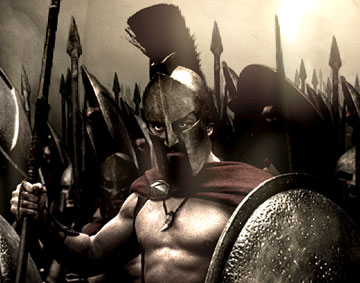
As some of you might know, I am a history buff. And I enjoy watching fantasy movies, so when those two things coincide, that's just my cup of tea.

Hollywood has recently rediscovered ancient Greece. I saw Alexander as well as Troy two or three years ago. And I agree, those were not the best of their kind ("Alexander The Great" with Richard Burton back from the 1950s is way better), their makers didn't care too much about the real historical background (the Trojan War as described in Homer's Iliad is at least partly legendary of course), but then again they never claimed to do so.

The latter is also true for the dream factory's latest artefact, "300" (the movie), which refers to the Battle of Thermopylae, when 300 Spartans under king Leonidas fought the Persian invasion army lead by their emperor Xerxes at the mountain pass of Thermopylae in 480 BC. The movie's artwork is based on Frank Miller's graphical novel of the same name.


I first saw the trailer back in November and its visual force simply blew me away, especially when combined with the background music by Nine Inch Nails. Again, let's not nit-pick about historical facts (e.g. there were several thousand Greek allies, not just 300 Spartans) - it's a novel after all. The movie also seems to mash in elements of Greek mythology, so there are appearances of cyclope-like creatures and similar characters.

I also noticed a scene where a Persian ambassador is thrown into a well by Leonidas. This goes back to the Persian tradition of demanding "earth and water" from their subordinates' soil as a symbol for accepting Persian domination on land and on sea. So the Spartans pitched them into the well and told them to go and look for earth and water down there. Now that's what I call coolness.

Samstag, 2. Dezember 2006

Matrix Twins

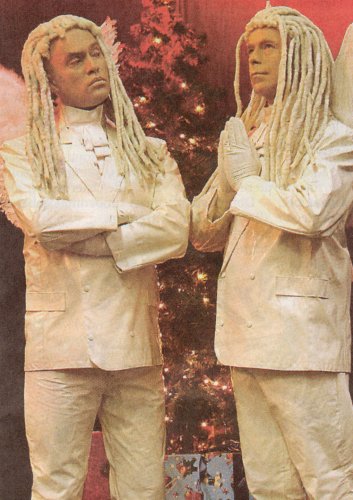
Some folks here provided their charity event promotion with some special Christmas eye candy:


There was something about those two. Don't get me wrong, it's not that I expect every Christmas angel to look baroquesque. It was just this vague sense of having seen them before...

Mittwoch, 6. September 2006

My Favorite Non-Tech Podcasts

History According To BobHomepageFeed
Matt's Today in HistoryHomepageFeed
Military History PodcastHomepageFeed
European Civilization from the Renaissance to the PresentHomepageFeed
US History: From Civil War to PresentHomepageFeed
General BiologyHomepageFeed
Evolution 101 PodcastHomepageFeed
The Big Bang and Creationism PodcastHomepageFeed
Physics For Future PresidentsHomepageFeed
Stanford Philosophy TalkHomepageFeed
WDR Zeitzeichen (german)HomepageFeed
FM4 Off Air (german)HomepageFeed

Donnerstag, 29. Juni 2006

Off To Rome

I am heading to Rome tomorrow, so please forgive the lack of new postings during the next days. I expect the city to be dead on my arrival as Italy will be playing against Ukraine in the soccer world cup at that time. Forza Italia!

Sonntag, 4. Juni 2006

The Big Bang And Creationism Podcast

Robert Lippens provides a scientific discussion of the big bang, inflationary theory, and general cosmology and takes a close look at creationism's conflicting views. I am still trying to catch up with all podcast episodes from the start - very interesting material. I am quite impressed - I don't think I would have been able to come up with something at this level as Robert does at the age of 17... and of course I also got caught by the theme music of "The good, the bad, and the ugly" at the beginning of the first episode. Now that was a movie I was watching frequently back when I was 17. ;-)

Montag, 20. März 2006

What's Your EQ (Entrepreneurial Quotient)?

I seem to score higher on geek tests than on entrepreneur tests, so I guess I'd rather stick with what I am doing already... ;-)

Guy Kawasaki's Entrepreneurial IQ Test

Take this test at Tickle
You scored 70-89%!

Guy Kawasaki was Apple's legendary Mac evangelist.

Dienstag, 31. Januar 2006

Alexander's First Textfile

My son Alexander was five months old when he typed the following:

0#
ä

äppppppppppppppijjjjjjjjjjjjjjjjjjjjj8j9
kiikkoooooooooooooooooooooooo
kkkkkkkkkkkkkkkkkkkkkkkkkkkkkkkkkk.....insddmsäs
xyCCCCCCCCCCYXX


ÄÖÖÖÖÖ


N

OK, it's not "Me Thinks It Is Like A Weasel", but not bad either for a start. E.g. note the root shell prompt at the beginning.

Of course I had to preserve the text for ensuing ages. ;-)

Mittwoch, 7. Dezember 2005

Sonntag, 4. Dezember 2005

Naturalism Vs. Intelligent Design

I just finished John Lennox' book "Has science buried god?" (in which he points out that the existence of our universe in its very shape is so unlikely to happen, it can impossibly have emerged coincidently), and I am now continuing my philosophical reading journey with his Darwinian counterpart Richard Dawkins ("The blind watchmaker"). Both excellently written and argued, it's somehow funny I even notice myself at times sympathizing with some of Lennox' ideas, even though I tend to disagree with his approach as a whole. There is a reason for this phenomenon: human thinking is not very well suited to grasp the magnitudes neither of the time horizon involved, nor of the number of places that could potentially allow life to emerge. To many people it just seems so unlikely for self-reproducing DNA/RNA to come into existence without a higher-level concept behind. But multiply that tiny tiny probability with the amount of time available (something like a billion years) and the number of planets in the universe (we can quite safely assume billions of billions of planets), it suddenly doesn't seem that unlikely at all.

Now this might not the right place for an in-depth metaphysical discussion, still it's interesting to note that about 40% or all Austrians believe in creationism or intelligent design, while another 40% have a pure naturalistic world view, with 20% indetermined (opposed to the US, where it's 80% creationists and 15% naturalists - of course I am oversimplifying here by dividing up only those two camps, but you get the point).

More people than I would have expected still stick to old-testamental genesis, something that has clearly been confuted by science nearly 150 years ago. Even the catholic church has taken a neutral position on evolution since the early 1950's.

The whole dispute just shows the dilemma we are all facing when it comes to issues that generally cannot really be proven by our usual approaches. There was a big bang, yes, which was caused by the concentration of matter, space and time in one singularity. At that point humans tend to search for the previous element in the cause-and-effect chain, but in this case there might not be anything previous. As of what came before, without matter there is no concept of time. And without time there is no "before", and there is no "cause and effect".

I consider myself a rational person, so that's what should guide me. I am quite convinced we are nothing but stardust. Still, a local newspaper article quoted a famous German journalist and TV host just the other day: "There are no atheists on an airplane during heavy turbulence". It seems inherently human to look for something that goes beyond logical reasoning. Is it just the fear of being alone in this universe and having to find sense in life without guidance from above? Or is rationalism simply not very well suited to answer this kind of questions?

Montag, 7. November 2005

What Star Wars Jedi Or Sith Character Is Most Like Your Personality?

You scored as Darth Revan. You are most like Darth Revan. Revan was considered charismatic, confident and a brilliant strategist who bore a strong connection with The Force. Though he fell to the Dark Side, due to several specific actions he undertook as the Dark Lord, some speculate he became the galaxy's greatest villain to protect the Republic from a powerful Sith empire thought long extinct.

You train in the lightsaber form Niman X which executes usage of dual lightsabers, an unorthodox style that while difficult to master can easily throw off many opponents.

Whether Jedi or Sith, your actions were influential.

Darth Revan

75%

Anakin Skywalker

71%

Bastila Shan

71%

Darth Vader

71%

Obi-Wan Kenobi (Pre Death of Qui-Gon Jinn)

68%

Mace Windu

68%

Exar Kun

68%

Darth Maul

64%

Luke Skywalker

54%

Qui-Gon Jinn

50%

Yoda

50%

Darth Sidious

50%

Count Dooku/Darth Tyranus

50%

Obi-Wan Kenobi (Post Death of Qui-Gon Jinn)

50%

What Star Wars Jedi or Sith character is most like your personality?

Freitag, 23. September 2005

The Meaning Of Life

Achievement-oriented people often experience a weird kind of emptiness shortly after they reach their goals. As Tom Landry, former head coach of the Dallas Cowboys, once put it:

"Even after you've just won the Super Bowl -- especially after you've just won the Super Bowl -- there's always next year. If "Winning isn't everything; it's the only thing," then "the only thing" is nothing -- emptiness, the nightmare of life without ultimate meaning."

I have never won the Super Bowl, but one of the small victories in my life was when I finished my second university degree. I was already working full time by then, so I had to sacrifice many evenings, weekends and most of my vacations for studying. After my final exam, I was satisfied and happy - for an hour or two. Then suddenly a sense of complete emptiness overwhelmed me. The goal which had fulfilled me before, it suddenly was gone. It took me several days of exploring new objectives, some at work, some regarding my personal life, until that feeling was gone again.

Still, just setting the next goal is only going circumvent the problem momentarily. On the long term it's a mistake to define the meaning of life by such one-dimensional purposes that will be accomplished sooner or later.